A solar-powered ADU can support coffee, cooking, work and a comfortable evening at home. What matters is how much energy you use, when you use it, and what happens when winter sunlight falls short.
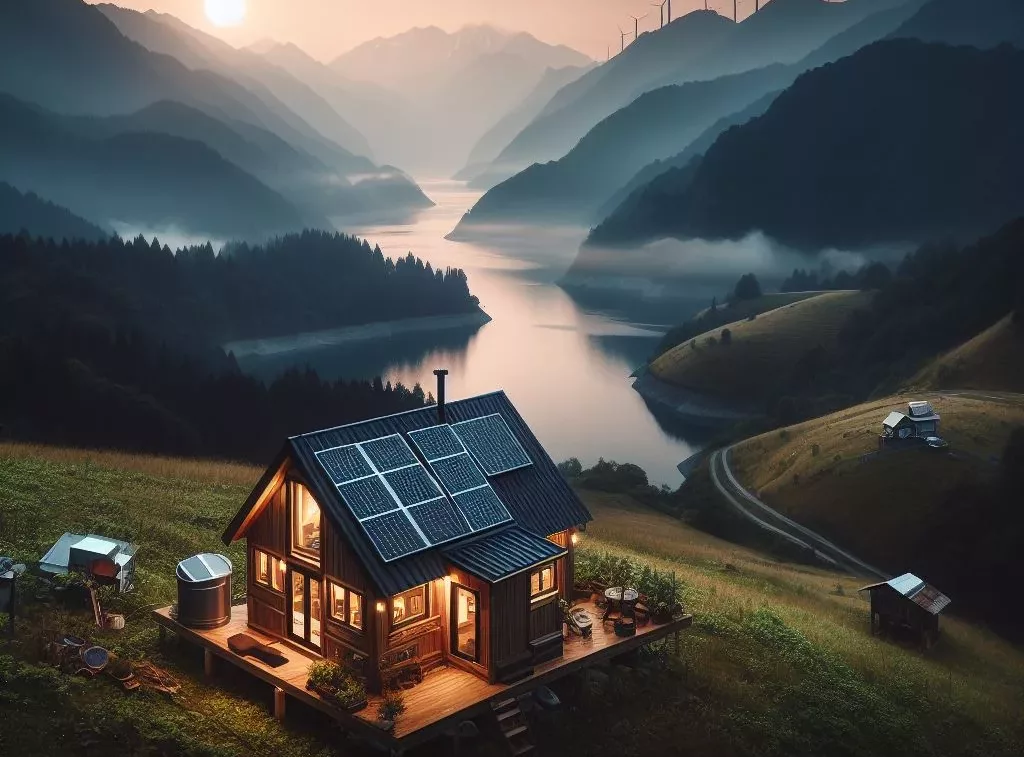
Featured image: illustrative solar-powered ADU concept.
Panels supply electricity when sunlight is available. A battery can carry some into the evening. Heating, hot water and cloudy days determine how much support the home needs.
- Plan around your appliances and local winter solar.
- Move flexible chores into periods with spare solar.
- Check daily energy, stored energy and simultaneous power separately.

Make the home work for you
Bring space, utilities and everyday living into one clear plan.
Explore the guideOne small home. An ordinary day.
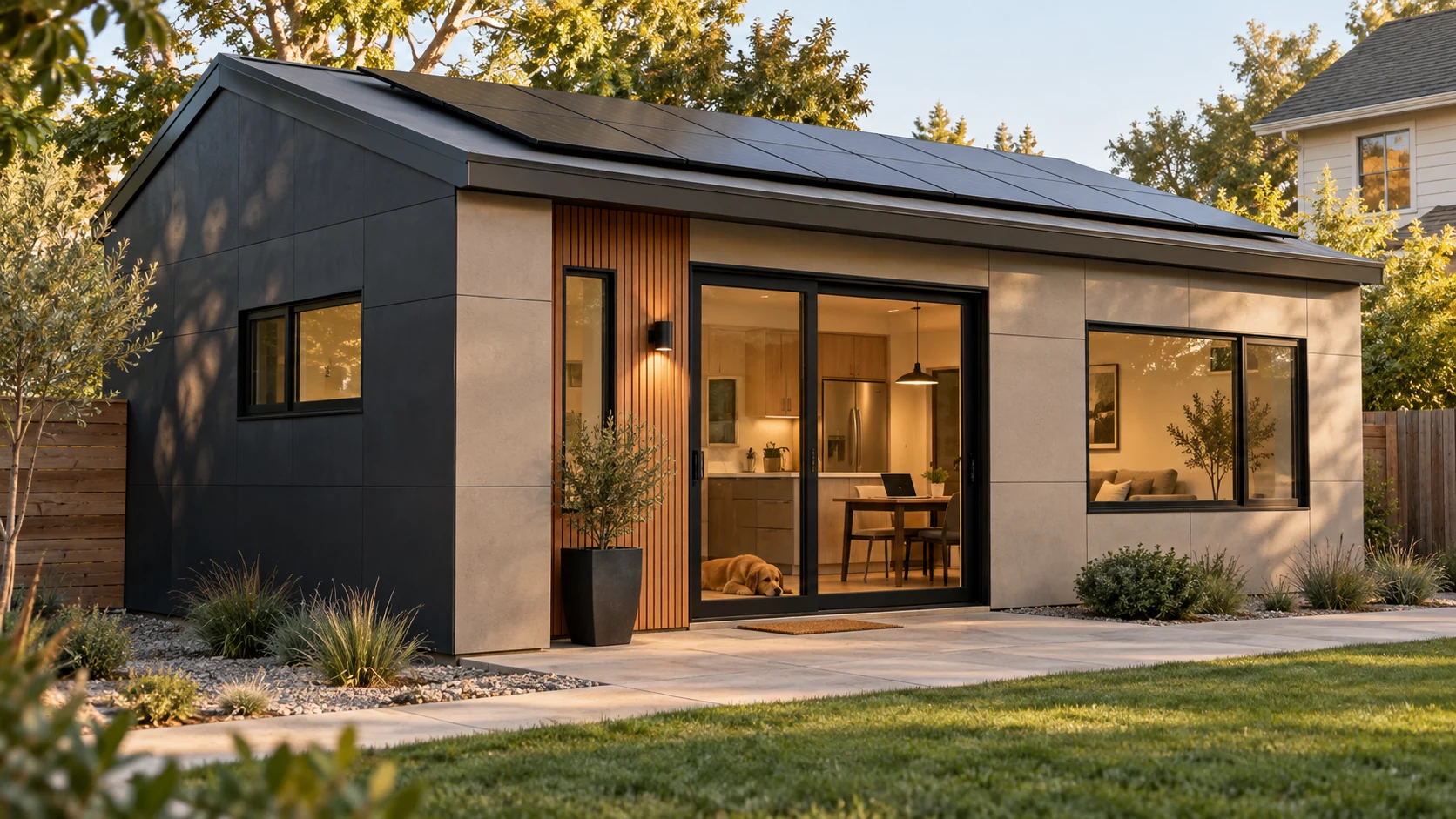
Our example is a modern, well-insulated 500 sq ft accessory dwelling unit: two adults, one working from home, and a dog who appreciates a comfortable spot to sleep. It uses efficient electric appliances, a mini-split and heat-pump hot water.
Morning
Coffee, breakfast and showers. Stored energy covers early demand while solar output rises.
Midday
Video calls, laundry and hot-water recovery. Run flexible loads when solar has spare capacity.
Evening
Induction dinner, television and lights. Solar fades; stored energy covers the evening, with backup if needed.
Overnight
Fridge, internet, ventilation and climate control keep working until morning.
This timeline assumes solar plus storage. Grid-connected homes can draw from the grid when needed. A morning shower uses stored hot water; it need not trigger immediate full-power heating.
Same chores. Better timing. Running a dishwasher on spare midday solar can reduce evening battery draw. The dishwasher still uses energy; moving it does not make that energy disappear.
What actually uses the energy?
On a day with one wash, dry and dishwasher cycle, our worked example uses 11.4 kWh in summer or 14.4 kWh in winter, including system standby. These are illustrative budgets for the same household, not measured ADU averages.
Where the energy goes
All values are kWh for an assumed day with one wash, dry and dishwasher cycle. Grey: winter heating. Orange: summer cooling and shared loads. The mini-split is allocated 3 kWh cooling or 6 kWh heating; hot water 1.5 kWh and heat-pump drying 1 kWh/cycle. These are worked assumptions, not predicted consumption. Standby assumes 10 W all day; fridge energy comes from a published annual rating divided by 365.
Why your calculator total may differ: this visual follows one day with laundry. The calculator spreads chores across a week and uses broader heating, hot-water and dryer scenarios based on your answers. The same home can have different daily totals.
Energy: the daily total
A 1,500 W appliance running for 20 minutes uses 0.5 kWh. Add each appliance’s energy to understand the day.
Power: everything at once
Cooking while a microwave and heating run can create a much larger instant demand. Your inverter must handle that combination.
This example excludes EV charging, oven baking, water/septic pumps and workshop equipment. Phones, ventilation and small standby loads share a 0.3 kWh allowance; check the actual equipment.
Heating and hot water deserve the closest attention. Insulation, weather, shower habits and heater settings change their demand. A heat-pump water heater also needs suitable air space or venting; placement matters in a compact home.
DOE · Heating and cooling loads · ENERGY STAR · Hot-water placement
Which loads matter most?
Use the Essential Power Planner to identify your priority loads, then explore the whole-home estimate below.
Plan essential powerInternet belongs in the energy budget
| Example setup | Assumed average | 24-hour energy |
|---|---|---|
| Broadband router + modem | 15 W | 0.36 kWh |
| Starlink + router | 100 W | 2.40 kWh |
Alternative example budgets, not measured specifications for every model. The day above uses broadband. Starlink hardware, heating mode and extra network equipment can change use; measure the complete setup and count it once.
Winter changes the picture
For a modelled 4 kW DC array—about nine 450 W panels by capacity—in Sacramento, July averages about 23.3 kWh/day; December averages 10.2 kWh/day.
The lowest three-day stretch within the model’s December produces 12.2 kWh altogether. With the same 6 kWh/day heating and 1.5 kWh/day hot-water allowances, two laundry loads a week and a dishwasher cycle every other day, the household’s averaged demand is about 38.9 kWh over three days. A charged battery, backup supply or lower demand must bridge the gap, with storage losses considered too. More battery storage buys time. More solar helps refill it.
The 4 kW array is a seasonal comparison, not a recommended system size. This is a typical-weather model sequence, not a forecast or worst-case design test. PVWatts · Model and methodology
Your biggest battery might be parked outside
A compatible electric vehicle with vehicle-to-home (V2H) support could help power your home during an outage. It needs a supported bidirectional charger and home integration equipment—and enough charge left for driving.
Confirm the vehicle, equipment and the circuits serving your ADU work together. V2H home backup differs from V2L outlets that power individual appliances. GM Energy · V2H requirements
What would your ADU need?
Start with our household, then change the details to match your life. The calculator shows a range for covering the selected month’s average daily use, with your chosen battery cover. Roof space and equipment power need their own checks.
Solar & battery estimate
Explore covering the selected month’s daily electricity use. Winter coverage can require much more solar than a grid-connected system designed around annual savings.
Example ready · Step 1 of 3
We’ve set up a modern 500 sq ft home for two adults. Check what fits yours; everyday appliance habits are already filled in below.
Adjust everyday habits
Averages include a fridge, lights, coffee, microwave and small loads. Laundry and dishwasher use are spread across the week. Internet budgets assume 15 W for broadband or 100 W for Starlink plus router; your equipment may differ.
“Not sure” gives a wider range. Gas, propane and wood options estimate their electrical demand only; fuel use is separate.
These five cities are examples, not a lookup for your address. Location and season affect sunlight and the heating/cooling scenarios. Check your actual site before choosing equipment.
Advanced assumptions
Midday/evening presets assume 45%/65% of daily energy passes through the battery. They do not simulate hourly solar surplus. Solar models use a 25° south-facing roof and 14% losses; extra site loss is applied afterwards. Backup assumes zero generation and includes recharge over the chosen number of average solar days. Panel rating defaults to 450 W. All are adjustable assumptions.
Keep your estimate
Send these numbers to your inbox.
One emailed estimate per address every 24 hours. Recalculate here anytime.
Your daily energy range
Bars show the higher-use scenario. Labels show both scenarios where assumptions differ.
These combine lower-use assumptions at one end and higher-use assumptions at the other. The upper number is not the expected size for every ADU; neither endpoint is a guaranteed bound. Insulation, comfort settings, showers, humidity and actual equipment can move consumption outside the range.
Daily kWh cannot tell you whether the inverter can run cooking, heating and other large loads together. Check continuous power, surge demand, voltage and equipment compatibility.
This is a monthly energy-coverage calculation, not proof of self-sufficiency. A smaller solar array can still help a grid-connected home. A monthly-average energy balance cannot guarantee overnight cover or off-grid operation through cloudy spells. Roof area, shading, snow, hourly demand and equipment limits need a site-specific design.
Explore home solar panels
Compare panel wattages and dimensions at A1 SolarStore, then confirm the complete system with your installer.
Explore solar panelsCheck current stock, delivery costs and minimum order quantities for your location.
How this estimate works
PVWatts AC output already includes the modelled inverter losses. The additional battery round-trip factor applies only to energy routed through storage. Reserve reduces available capacity; it is not charged as an extra daily loss. Battery result uses a generic nominal DC rating; a product’s usable AC rating needs a different comparison.
Guided climate assumptions: a square, single-storey home, 2.4 m ceilings and windows equal to 20% of wall area. Insulation choices set broad assumed heat-loss ranges. Hourly outdoor temperatures produce heating degree-hours below 18°C and cooling degree-hours above 24°C. Heat-pump heating uses assumed efficiency (COP) 2–4; cooling uses 2.5–4 plus an assumed internal/solar heat allowance. This is a simplified scenario model, not a Manual J calculation; cold-weather backup heat, humidity, defrost and actual equipment performance need separate assessment. Hot-water and dryer use also use assumed ranges. The reader-facing tool estimates these from your home and equipment choices; it asks for no daily heating or hot-water energy figure.
Location data: PVWatts v8.5.0, NSRDB TMY weather, retrieved 8 October 2026. Linear scaling assumes the same array orientation, loss inputs and DC/AC ratio. The model is not affiliated with or endorsed by DOE/NLR.
Keep this tool handy: open the standalone solar & battery calculator.
Build for the life you want
A useful plan starts with your actual appliances, an efficient building and local winter conditions. Check the roof space, battery energy, inverter power and backup together before choosing panels.
Solar panels alone do not guarantee outage power: the system needs suitable backup equipment and configuration. DOE explains the backup requirements.
Solar-powered also does not automatically mean off-grid. If independence from utilities is the goal, read Can an ADU Be Off-Grid? Beyond Solar Panels for the water, wastewater and approval decisions.
Bring the decisions together
Plan the space, systems and everyday details before you build.
Explore the guideSources and example assumptions
- JinkoSolar · Example panel dimensions (PDF)
- DOE · Site-specific heating and cooling sizing
- PVWatts · Solar model
- DOE · Solar and resilience
- ENERGY STAR · Washing and energy boundaries
- ENERGY STAR · Dishwasher test energy
- ENERGY STAR · Heat-pump dryers
- GE · Example refrigerator annual rating
The article’s worked day assumes one wash/dry and dishwasher cycle, 3 kWh cooling or 6 kWh heating, 1.5 kWh hot water, 1 kWh heat-pump drying and 0.24 kWh system standby. The three-day comparison uses weekly-average chores instead. Calculator climate, water and dryer ranges are separate illustrative scenarios; none of these figures is a measured whole-home consumption claim.